May 18, 2026652ComparisonWater Filter Pitcher
Best Water Filter Pitchers Compared – 2026
This comparison evaluates five top water filter pitchers for everyday drinking water, examining their contaminant reduction capabilities, capacity, and ease of use. We tested the Waterdrop 10-Cup, Clearly Filtered, and JOEY'Z Ultrafiltration models alongside premium electric options. Each pitcher offers different strengths in filtration technology, from basic chlorine removal to advanced PFAS reduction.
As an Amazon Associate I earn from qualifying purchases at no cost to you – it keeps the site running.
Related guides
Waterdrop 10-Cup – Best Brand Pick

Overview: The Waterdrop 10-Cup features NSF 42 and 372 certifications with a distinctive wooden handle design and hands-free spout lid. Its 200-gallon filter life spans approximately 5 times longer than standard pitcher filters, reducing chlorine by up to 97.4%. This pitcher targets households seeking reliable filtration with convenient refilling and attractive aesthetics.
What sets the Waterdrop 10-Cup apart from competitors like the Clearly Filtered and JOEY'Z models is its innovative spout lid design that eliminates the need to remove the top for refilling. The natural wood handle provides ergonomic comfort while giving the pitcher a premium appearance that stands out from typical plastic designs. Its NSF certifications focus primarily on chlorine reduction and lead removal, making it suitable for municipal water improvement rather than comprehensive contaminant elimination.
The 200-gallon filter capacity significantly outlasts the Nakii's 150-gallon rating and standard 40-gallon filters, reducing long-term maintenance costs. However, the wooden handle requires more careful cleaning than all-plastic alternatives, and the 10-cup capacity may feel limiting for larger families compared to the 15-cup electric model from the same brand.
Pros
Hands-free spout lid eliminates need to remove top for refilling
200-gallon filter life reduces replacement frequency and costs
NSF 42 and 372 certifications verify chlorine and lead reduction claims
Ergonomic wooden handle provides comfortable grip and premium aesthetics
Compact design fits in most refrigerator doors
Cons
Wooden handle requires more careful cleaning than all-plastic designs
Limited to basic contaminant reduction compared to advanced filtration systems
10-cup capacity may be insufficient for larger households
Best for Households wanting reliable chlorine reduction with convenient refilling and attractive design elements.
Clearly Filtered – Best Contaminant Removal

Overview: The Clearly Filtered pitcher utilizes proprietary Affinity Filtration Technology to remove up to 99.9% of 365+ contaminants including fluoride, PFAS, and microplastics. Its 100-gallon filter life and medical-grade Tritan construction target health-conscious users seeking comprehensive water purification. The August 2024 redesign features improved ergonomics and an easy-fill hinged lid.
The Clearly Filtered system stands apart from basic chlorine-reduction pitchers like the Waterdrop models by targeting an extensive range of contaminants including fluoride, PFAS, and arsenic that most competitors cannot address. Its proprietary filtration technology goes beyond standard activated carbon approaches used in the Nakii and JOEY'Z systems, though this comprehensive filtration comes with slower flow rates typical of advanced multi-stage systems. The medical-grade Tritan construction ensures no leaching concerns that can affect cheaper plastic alternatives.
While the 100-gallon filter life falls between the Waterdrop's 200-gallon capacity and standard 40-gallon filters, the comprehensive contaminant removal justifies more frequent replacements for users prioritizing water purity. The redesigned ergonomic handle and hinged lid address previous usability concerns, though the slower filtration speed requires more patience compared to basic carbon-only systems.
Pros
Removes 99.9% of 365+ contaminants including fluoride and PFAS
Medical-grade Tritan construction prevents plastic leaching
Proprietary Affinity Filtration Technology exceeds standard carbon filtering
Redesigned ergonomic handle and easy-fill hinged lid improve usability
100-gallon filter life provides reasonable replacement intervals
Cons
Slower filtration speed due to comprehensive multi-stage process
Higher filter replacement costs reflect advanced filtration technology
Best for Health-conscious users seeking comprehensive contaminant removal including fluoride and PFAS reduction.
Nakii – Best Family Pick
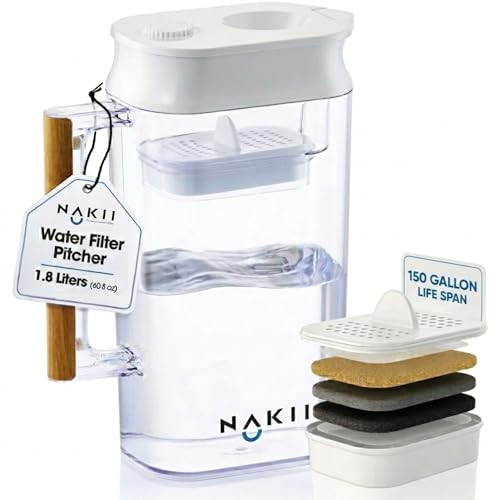
Overview: The Nakii pitcher features Activated Carbon Fiber (ACF) technology with a 150-gallon filter life and WQA certification for chlorine and mercury removal. It achieves 98% chlorine reduction while targeting heavy metals, sediment, and taste issues in municipal water. This system focuses on families needing reliable filtration with extended filter replacement intervals.
The Nakii's Activated Carbon Fiber technology differentiates it from standard granular carbon systems found in basic pitchers, providing more surface area for contaminant adsorption than traditional approaches. Its 150-gallon filter life falls between the Waterdrop's 200-gallon capacity and the Clearly Filtered's 100-gallon rating, offering a middle ground for replacement frequency. The WQA certification provides third-party verification of chlorine and mercury reduction claims, though it lacks the comprehensive contaminant range of the Clearly Filtered system.
While the ACF technology provides superior chlorine removal compared to basic carbon filters, it cannot match the advanced multi-stage filtration of systems like Clearly Filtered for emerging contaminants such as PFAS. The pitcher design follows conventional gravity-fed operation without the convenience features found in the Waterdrop models, requiring lid removal for refilling and standard flow rates that slow as filters age.
Pros
Activated Carbon Fiber technology provides superior surface area for contaminant adsorption
150-gallon filter life reduces replacement frequency compared to standard filters
98% chlorine reduction rate verified through WQA certification
Effective heavy metal removal including mercury and lead
Competitive pricing for extended filter life and ACF technology
Cons
Limited contaminant range compared to advanced multi-stage systems
Conventional design lacks convenience features like hands-free refilling
Flow rate decreases as filter approaches replacement time
Best for Families seeking reliable chlorine and heavy metal reduction with extended filter life at competitive pricing.
JOEY'Z Ultrafiltration – Best Microplastic Removal

Overview: The JOEY'Z pitcher combines activated carbon with a 0.01 micron ultrafiltration membrane to block microplastics, harmful microbes, and sediment while reducing chemicals and heavy metals. It includes two filters and an electronic change indicator with compatibility for standard replacement filters. This system targets users concerned about physical contaminants and microbial safety in their drinking water.
The ultrafiltration membrane technology sets the JOEY'Z system apart from carbon-only approaches used in the Waterdrop and Nakii models by physically blocking contaminants at the 0.01 micron level, including microplastics and harmful microbes like Giardia and E. coli. This dual-action approach combines chemical adsorption through activated carbon with physical filtration barriers, providing broader protection than single-technology systems. The electronic filter indicator eliminates guesswork about replacement timing that affects other models.
While the ultrafiltration membrane excels at removing physical contaminants, it cannot match the chemical contaminant range of advanced systems like Clearly Filtered for dissolved substances such as fluoride or PFAS. The 0.01 micron pore size may also result in slower flow rates compared to carbon-only systems, and the membrane component requires more careful handling during filter changes than standard carbon cartridges.
Pros
0.01 micron ultrafiltration membrane physically blocks microplastics and microbes
Dual-technology approach combines carbon adsorption with membrane filtration
Electronic filter change indicator eliminates replacement guesswork
Effective against harmful microbes including Giardia and E. coli
Compatible with standard replacement filters for cost flexibility
Cons
Slower flow rates due to fine membrane filtration requirements
Limited chemical contaminant removal compared to advanced multi-stage systems
Membrane component requires careful handling during filter replacement
Best for Users prioritizing microplastic removal and microbial safety with physical filtration technology.
Loading comments...