Loading...
Overview: The 70mai T800 4K Dash Cam delivers 3-channel coverage — front, rear, AND interior cabin — through one of the most established names in the consumer dash cam category. 4K front resolution captures license-plate-distance detail, the interior camera handles rideshare and family-driver use cases that 2-channel cameras cannot serve, and Wi-Fi 6 plus voice control modernize the user interaction beyond older button-based dash cams. 70mai's ecosystem (often associated with Xiaomi distribution) brings longer firmware support than budget-brand alternatives.
3-channel dash cams add the interior cabin angle that 2-channel front-and-rear configurations cannot capture. For most private drivers this is optional, but for rideshare drivers, family drivers monitoring younger passengers, fleet vehicles, or anyone wanting accountability evidence for in-vehicle incidents, the third channel is the difference between recording a complete event and recording only the driving context. The interior camera includes infrared night vision so cabin recording works in dark conditions where standard sensors would only capture silhouettes.
Wi-Fi 6 is a meaningful upgrade over older Wi-Fi 4/5 dash cams. Footage transfer to phones is dramatically faster — pulling a 5-minute 4K clip takes seconds rather than minutes — which removes the friction that prevents many users from actually reviewing their dash cam footage when they need to. Voice control adds hands-free operation for marking incidents while driving (saving a clip from being overwritten by loop recording when something happens). 70mai's firmware support history is among the longest in the consumer dash cam category — the brand has been releasing firmware updates for cameras 3-5 years after launch, which matters more in dash cams than most categories because the devices are typically left installed for years.
Pros
3-channel coverage — front 4K, rear, and interior cabin in single unit
4K front resolution — license-plate-distance identification
Wi-Fi 6 — substantially faster footage transfer than older Wi-Fi standards
Voice control — hands-free clip marking while driving
GPS included — speed and location data on every recording
70mai brand — strong firmware support history and ecosystem
Interior infrared night vision — cabin recording works in dark conditions
Cons
3-channel install requires routing rear cable plus interior camera positioning — more involved than 2-channel setups
Rear and interior channels at 1080P — only the front captures 4K
Slightly higher price than 2-channel 4K alternatives without interior camera
Voice control accuracy varies in noisy cabin conditions
Best for Rideshare drivers, family drivers, and anyone wanting interior cabin coverage alongside front-and-rear recording, especially buyers who value 70mai's longer firmware support timeline over newer budget-brand alternatives.
Overview: REDTIGER F77 is the only unit in this comparison recording 4K on both front AND rear channels simultaneously — dual STARVIS 2 IMX678 sensors for HDR 4K footage in both directions. The built-in 128GB eMMC storage eliminates SD card management entirely, a unique feature at this price tier. 4" touch screen, 5.8GHz WiFi, voice control, and GPS round out a feature set that REDTIGER positions as their flagship 4K offering.
Dual 4K with dual STARVIS 2 IMX678 sensors is the F77's defining technical achievement. Most dash cams compromise rear resolution — 4K front with 1080P rear is the typical allocation. REDTIGER F77 applies the same Sony STARVIS 2 second-generation CMOS to both channels, delivering low-light performance and HDR capability front and rear. For rear-end collision scenarios where the rear channel captures the approaching vehicle's plate, 4K resolution and STARVIS 2 low-light quality are directly relevant to incident documentation quality.
Built-in 128GB eMMC storage is the other standout differentiator. Standard dash cams rely on SD cards — which require periodic replacement (SD cards have limited write cycles under continuous overwrite), risk data loss from card failure, and require manual removal for footage access. REDTIGER F77's internal eMMC is a more reliable storage substrate with higher write endurance, and it eliminates the card management workflow entirely. The 5.8GHz WiFi provides fast footage transfer to smartphone; the 4" touch screen is the largest display in this comparison for comfortable on-device review. Voice control allows hands-free operation for photo capture, recording start/stop, and settings adjustment. 24-hour parking mode covers unattended incidents.
Pros
Dual 4K: 4K+4K front AND rear – only unit in this comparison with full 4K both directions
Dual STARVIS 2 IMX678 HDR – Sony's best sensor on both channels for night legibility and HDR
Built-in 128GB eMMC – higher endurance storage, no SD card management or replacement cost
4" touch screen – largest display in this comparison for live preview and clip review
5.8GHz WiFi + GPS + voice control + 24H parking mode – full feature set
Cons
Front+rear only – no cabin channel vs. VIOFO A229 Pro's 3-channel at comparable 4K tier
Built-in 128GB storage is fixed — can't expand beyond eMMC capacity (though 128GB is substantial)
Higher price point than Juscar and single-channel VIOFO alternatives at the 4K tier
Best for Drivers who want genuine 4K quality on both front and rear channels with STARVIS 2 HDR, and value built-in eMMC storage over SD card management for a maintenance-free recording setup.
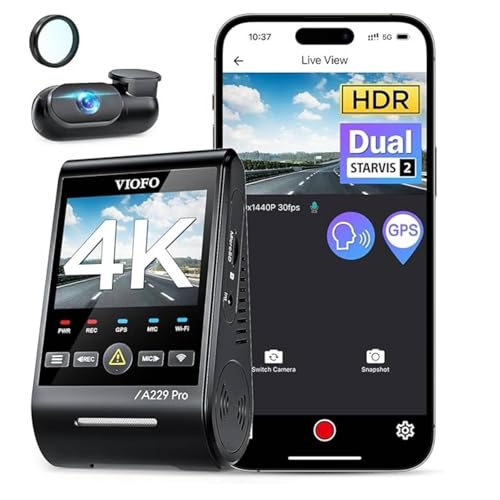
Overview: VIOFO A229 Pro is the 3-channel 4K reference in this comparison — 4K front, 2K cabin, and 1080P rear with dual STARVIS 2 sensors (IMX678 front + IMX675 cabin). VIOFO is the established enthusiast-grade brand in the dash cam market, and the A229 Pro represents their current best at the 3-channel 4K tier: sensor quality, GPS, WiFi, and 24-hour parking mode in a system trusted by the dash cam community.
VIOFO's standing in the dash cam enthusiast community is comparable to VANTRUE's — both brands are recommended in dashcam review forums as quality-first alternatives to mass-market budget units. The A229 Pro's dual STARVIS 2 sensor configuration applies Sony's second-generation CMOS to both the front (IMX678, the same sensor as REDTIGER F77's dual channels) and the cabin (IMX675, same as REDTIGER F17's front channel). In a 3-channel system, the cabin camera is often the weakest link — standard cabin sensors perform poorly in the low-ambient-light conditions of a parked interior. IMX675 in the cabin channel is a meaningful quality step up.
4K+2K+1080P resolution allocation reflects a considered balance: the front channel at 4K with IMX678 delivers maximum plate legibility for forward incidents; the cabin at 2K with IMX675 provides substantially better interior detail than 1080P cabin alternatives; the rear at 1080P covers trailing incidents at standard resolution. 5GHz WiFi enables fast footage download; GPS embeds speed and location for incident reconstruction. Voice control allows hands-free commands for photo capture and recording status. VIOFO's 24-hour parking mode implementation uses hardwire kit low-voltage cutoff protection to avoid battery drain — a more refined parking solution than simple timer-based cutoffs. For 3-channel 4K buyers who want enthusiast-vetted quality and STARVIS 2 on both front and cabin channels, the A229 Pro is the reference choice.
Pros
Dual STARVIS 2: IMX678 (front 4K) + IMX675 (cabin 2K) – Sony second-gen on both primary channels
4K+2K+1080P – best resolution allocation in the 3-channel category of this comparison
VIOFO brand – enthusiast-community-vetted quality and reliability track record
5GHz WiFi + GPS + voice control + 24H parking mode – full enthusiast feature set
2K cabin vs. 1080P cabin alternatives – meaningfully better interior detail
Cons
Premium 3-channel price vs. WOLFBOX and Veipho budget 3-channel alternatives
No built-in storage – relies on SD card (up to 256GB typically supported)
VIOFO's companion app is functional but less polished than Veipho's app-first approach
Best for Enthusiast 3-channel buyers who want dual STARVIS 2 sensor quality across front and cabin channels with VIOFO's community-trusted reliability, and prioritize image quality across all three channels over budget pricing.
Overview: VIOFO A229 Ultra is the top-of-range in this comparison — dual 4K front channels plus 1080P rear, triple STARVIS 2 sensors across all three cameras, and a 210° fisheye cabin camera that delivers full-interior coverage from a single lens. Super Night Vision 2.0 and faster 5GHz WiFi represent VIOFO's current-generation performance ceiling in the 3-channel 4K category.
The 210° fisheye cabin camera is the A229 Ultra's architectural differentiator. Standard cabin cameras use a conventional lens with roughly 120–140° field of view — adequate for center-aisle and front-seat coverage, but missing rear-seat passengers and corner blind spots in larger vehicles. The 210° fisheye covers the entire interior from a single camera position, eliminating the blind spots that matter for rideshare documentation and family-vehicle interior recording. The trade-off is fisheye lens distortion in raw footage — a characteristic that experienced dash cam users manage through software de-warping in post-processing, but which may affect real-time clip review clarity.
Triple STARVIS 2 sensors across all three channels is VIOFO's premium configuration: every camera in the system uses Sony's second-generation CMOS. For 4K comparison purposes: the A229 Ultra matches the REDTIGER F77's dual 4K front+cabin performance while adding a dedicated 1080P rear channel, making it the most comprehensive sensor configuration in this roundup. Super Night Vision 2.0 is VIOFO's current-generation low-light processing stack — improved noise reduction and brightness recovery vs. the A229 Pro's standard night vision implementation. Faster 5GHz WiFi accelerates dual-4K clip downloads; GPS with smart voice control enables hands-free operation. For buyers who want VIOFO's reference-grade quality with triple STARVIS 2, 210° interior coverage, and dual 4K, the A229 Ultra is the unconstrained option.
Pros
Triple STARVIS 2 sensors – Sony second-gen CMOS on all three channels including rear
Dual 4K HDR front channels + 1080P rear – maximum resolution across primary capture directions
210° fisheye cabin camera – full interior coverage from a single lens, eliminates blind spots
Super Night Vision 2.0 – VIOFO's current-generation low-light processing, improved over A229 Pro
Faster 5GHz WiFi + GPS + smart voice control – current-generation connectivity
VIOFO brand – enthusiast-vetted reliability at the premium tier
Cons
Highest price in this comparison
210° fisheye distortion requires software de-warping for natural-perspective clip review
3-camera system requires more complex cable routing than front+rear dual-channel alternatives
Best for Buyers who want VIOFO's top-of-range 3-channel configuration with triple STARVIS 2, dual 4K, 210° interior coverage, and Super Night Vision 2.0 — particularly rideshare drivers who need complete interior documentation from a single cabin camera.
Sign in to leave a comment.