Loading...
Best Portable Air Conditioners for Large Rooms Compared – 2026
The best portable air conditioners for large rooms cool spaces from 400 to 800 square feet. We compare 14,000–16,000 BTU units – including inverter and dual-hose models – across real cooling performance, energy efficiency, noise levels, and value.
As an Amazon Associate I earn from qualifying purchases at no cost to you – it keeps the site running.
As an Amazon Associate I earn from qualifying purchases at no cost to you – it keeps the site running.
AKIRES 14,000 BTU Portable Air Conditioner

Overview: AKIRES 14,000 BTU Portable Air Conditioner targets large rooms in the 400–600 sq.ft range with standard 3-in-1 functionality covering cooling, fan, and dehumidifier modes. As a value-positioned entry in the 14,000 BTU ASHRAE large-room tier, it targets buyers who need reliable cooling capacity without the brand premium or smart-inverter pricing of alternatives in this comparison.
14,000 BTU ASHRAE places AKIRES in the large-room portable AC category. Buyers comparing portable ACs should use the DOE/SACC-equivalent figure for room size matching – 14,000 BTU ASHRAE translates to approximately 8,000–10,000 BTU DOE, which covers spaces in the 400–600 sq.ft range under typical heat-load conditions. The ASHRAE rating reflects testing under high-temperature, high-humidity conditions and overstates real-world output for the same reason that a car's horsepower figure differs from its performance in everyday driving conditions.
AKIRES is a newer brand in the portable AC category without the established track record of Candy or the technology differentiation of ZAFRO's smart inverter at this comparison's premium tier. The value proposition is 14,000 BTU ASHRAE large-room cooling at accessible pricing – for buyers who need the cooling capacity and aren't paying for brand credentials or advanced features, AKIRES provides that combination. Standard portable AC installation applies: window exhaust kit, casters for repositioning, and plug-in 115V power.
Pros
14,000 BTU ASHRAE large-room coverage appropriate for 400–600 sq.ft spaces
Standard portable installation – no permanent window or wall modification required
3-in-1 function covers cooling, fan, and dehumidifier modes
Value price positioning in the 14,000 BTU tier relative to established brand alternatives
Cons
AKIRES is a newer brand with limited independent review depth versus established alternatives
Single-hose design reduces effective DOE efficiency versus the dual-hose ZAFRO in this comparison
14,000 BTU ASHRAE ≈ 8,000–10,000 BTU DOE – buyers should match room size to the DOE figure, not ASHRAE
Best for Large-room buyers who want 14,000 BTU ASHRAE cooling capacity at a value price point and are comfortable with a newer brand in exchange for competitive pricing.
CANDY 14,000 BTU Portable Air Conditioner

Overview: CANDY is an established Italian appliance brand (part of the Haier group) bringing a 14,000 BTU ASHRAE portable air conditioner to the large-room segment. For buyers who weight long-term reliability and brand manufacturing history in a significant appliance purchase, Candy provides established credentials at the same BTU tier as the value-positioned AKIRES alternative in this comparison.
CANDY's position in this comparison is brand credentialing at the 14,000 BTU ASHRAE tier. As an established Italian appliance manufacturer (part of the Haier group), Candy brings a manufacturing history and quality track record that newer brands in this comparison have not yet accumulated. For a portable AC expected to run 8–12 hours daily across multiple cooling seasons, build quality and component longevity have compounding relevance beyond what a first-season comparison reveals.
14,000 BTU ASHRAE provides the same raw cooling capacity as AKIRES at this tier – the distinction is brand reliability expectation, after-sales support infrastructure, and pricing. Candy typically prices at a slight premium to pure value brands at equivalent BTU ratings while remaining accessible compared to the premium smart-inverter ZAFRO. The DOE equivalent for 14K ASHRAE (approximately 8,000–10,000 BTU) covers large rooms in the 400–600 sq.ft range, and the 3-in-1 cooling, fan, and dehumidifier functionality covers the standard use case portfolio. Standard window kit installation applies.
Pros
Established Italian appliance brand (Haier group) – manufacturing reliability credentials above newer entrants
14,000 BTU ASHRAE large-room coverage for 400–600 sq.ft spaces
Brand support infrastructure and parts availability vs. newer brands
3-in-1 cooling, fan, and dehumidifier functionality
Portable installation with window exhaust kit – no permanent modification required
Cons
Price premium over value brands at the same 14,000 BTU ASHRAE rating
Single-hose design reduces real-world DOE efficiency versus the dual-hose ZAFRO
Less prominently marketed in the US compared to its established European presence
Best for Large-room buyers who prioritize brand manufacturing reliability and established after-sales support over maximum value-per-BTU, and want European-quality build credentials at the 14,000 BTU tier.
QZMDSM 16,000 BTU Portable Air Conditioner

Overview: QZMDSM leads this comparison on raw BTU output with a 16,000 BTU ASHRAE rating – the highest capacity portable AC in this roundup. For larger spaces in the 600–800 sq.ft range or rooms with elevated heat loads (west-facing, high ceilings, poorly insulated), QZMDSM provides the headroom that 14,000 BTU units cannot. The trade-off is higher energy draw and larger physical footprint versus the 14,000 BTU alternatives.
QZMDSM's differentiation in this comparison is BTU headroom. 16,000 BTU ASHRAE (approximately 10,000–12,000 BTU DOE equivalent) enables cooling of larger or higher-heat-load spaces that 14,000 BTU units would struggle with during peak afternoon conditions. For buyers in climates with sustained high temperatures or rooms with significant solar gain, the extra BTU capacity means the unit reaches and maintains setpoint temperature without cycling at full capacity continuously – a factor in both comfort and component longevity.
The practical considerations for 16K vs. 14K BTU portable ACs: higher peak energy consumption (typically 1,400–1,600W vs. 1,200–1,400W), larger physical dimensions requiring more floor space, and slightly higher acoustic output at maximum capacity. For rooms that genuinely need 16,000 BTU ASHRAE coverage, QZMDSM provides the top-tier capacity in this comparison; for standard large rooms at the 400–600 sq.ft range, the 14,000 BTU alternatives provide equivalent comfort without the additional overhead.
Pros
16,000 BTU ASHRAE – highest capacity in this comparison, covers 600–800 sq.ft spaces
Additional cooling headroom for high-heat-load environments (west-facing rooms, poor insulation, high ceilings)
Handles peak summer temperatures that 14,000 BTU units cycle continuously through
3-in-1 cooling, fan, and dehumidifier modes
Cons
Higher energy consumption than 14,000 BTU alternatives at equivalent settings
Larger physical footprint – requires more floor space than lower-BTU portable ACs
Excess capacity for standard 400–600 sq.ft rooms – buyers pay for BTUs they may not need
QZMDSM is a value-brand positioning without established track record
Best for Buyers with genuinely large spaces (600–800 sq.ft) or elevated heat loads who need maximum BTU capacity in a portable form factor and can accept higher energy draw versus 14K BTU alternatives.
ZAFRO Smart Inverter Portable Air Conditioner
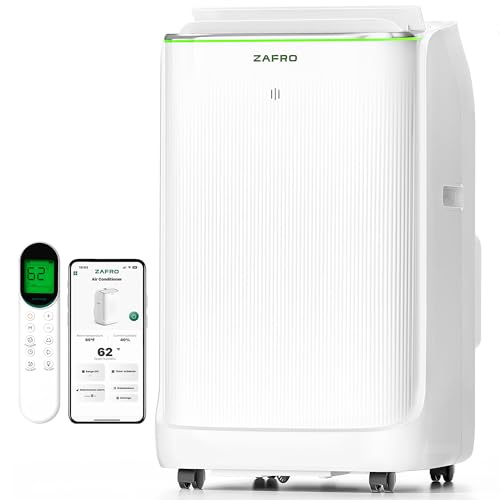
Overview: ZAFRO brings inverter compressor technology to the portable AC category – a meaningful differentiation from the fixed-speed compressors in the other units in this comparison. Inverter technology modulates compressor speed to match real-time cooling demand rather than cycling on/off at full capacity, resulting in more consistent temperatures, quieter operation at partial load, and lower energy consumption during sustained runtime.
ZAFRO's inverter compressor is the technical differentiator in this comparison. Standard portable ACs use fixed-speed compressors that cycle on at full power, cool the room, shut off, then restart when temperature rises – a pattern that creates temperature fluctuation, higher peak energy draw, and more wear cycles on the compressor. Inverter technology modulates output continuously: the compressor slows when the setpoint is nearly reached and ramps up when demand increases, maintaining tighter temperature bands with lower energy consumption during the sustained runtime periods that matter most in a portable AC context.
The dual-hose design adds a second practical advantage: standard single-hose portable ACs exhaust hot air out while drawing replacement air from the cooled room, creating slight negative pressure that pulls warm outside air through gaps around doors and windows. ZAFRO's dual-hose design takes intake air from outside and exhausts it outside, eliminating this infiltration inefficiency. For sealed or well-insulated rooms, the efficiency difference is measurable. The premium price over fixed-speed alternatives in this comparison reflects both the inverter component cost and the dual-hose design – buyers who run their portable AC for extended periods daily during cooling season can expect the efficiency gains to partially offset the price differential over time.
Pros
Inverter compressor modulates output for consistent temperature and quieter partial-load operation
Dual-hose design eliminates warm air infiltration – more efficient than single-hose alternatives
Lower energy consumption during sustained runtime vs. fixed-speed compressors
Fewer compressor on/off cycles reduces long-term wear versus fixed-speed units
Smart controls with app connectivity for remote temperature management
Cons
Premium price over fixed-speed 14,000 BTU alternatives in this comparison
Dual-hose installation requires two exhaust connections vs. single-hose simplicity
Inverter efficiency gains require sustained runtime to offset price premium – less favorable for occasional use
Best for Buyers who run their portable AC for extended daily periods and want the efficiency, temperature consistency, and noise reduction of inverter technology at a premium over standard fixed-speed portable ACs.
Loading comments...