Loading...
Best Kids & Family Body Sunscreen Compared 2026
April 21, 2026This comparison covers the top body sunscreens for kids and families in 2026, targeting parents who want reef-safe, non-toxic mineral formulas gentle enough for babies, toddlers, and children with sensitive skin. Featured products from NATÚ Botanicals, Happy Ocean, Clean + Kind, Vigority, and Waxhead span SPF 35 to SPF 50 with tinted, tallow-based, and high-zinc options for daily family use and outdoor activities.
As an Amazon Associate I earn from qualifying purchases at no cost to you – it keeps the site running.
As an Amazon Associate I earn from qualifying purchases at no cost to you – it keeps the site running.
NATÚ BOTANICALS Tinted Mineral Sunscreen SPF 35

Overview: NATÚ BOTANICALS Tinted Mineral Face and Body Sunscreen SPF 35 is a botanical-rich zinc oxide sunscreen using avocado oil, cocoa butter, and beeswax for hydration alongside broad-spectrum UVA/UVB protection. It is reef safe, tinted for reduced white cast, lightweight, and formulated for sensitive skin across all ages for face and body use.
The tinted format in a family sunscreen serves a practical purpose beyond cosmetics: it allows parents and users to see exactly where the sunscreen has been applied, reducing missed spots on children's skin. Combined with the botanical base of avocado oil and cocoa butter, the tinted result blends across a range of skin tones while leaving skin conditioned rather than dried out – a meaningful consideration for children's skin that regular exposure to sunscreen, salt water, and chlorine can dehydrate over time.
Avocado oil is a rich emollient high in oleic acid and vitamins E and K, providing moisturizing depth appropriate for dry or sensitive skin. Cocoa butter adds a protective occlusive layer that helps lock in moisture. Beeswax provides a natural film-forming property that improves the formula's ability to stay on skin through minor water exposure. Together these ingredients make this a skin-nourishing formula rather than a basic UV application. SPF 35 is in the middle tier of this comparison's protection range – appropriate for daily activity but worth noting for extended peak-hour outdoor use where SPF 50 provides more margin.
Pros
Tinted format helps parents confirm even coverage and identify gaps on children's skin during application
Botanical base (avocado oil, cocoa butter, beeswax) nourishes and conditions skin alongside UV protection
Reef safe zinc oxide – appropriate for ocean and coastal environments for the whole family
Lightweight lotion for face and body – versatile for whole-family use across ages
Formulated for sensitive skin – accessible for children and adults with reactive skin types
Cons
SPF 35 is lower than SPF 50 options in this comparison – relevant for extended outdoor exposure at peak UV hours
Tinted formula requires shade consideration – not universally matching across all skin tones
Cocoa butter and beeswax base may feel heavier in warm weather compared to lighter lotion alternatives
Best for Families who want a botanically nourishing reef-safe SPF for sensitive skin across all ages, and value tinted coverage for application confirmation alongside a moisturizing botanical ingredient profile.
Happy Ocean Kids Mineral Sunscreen SPF 45

Overview: Happy Ocean Kids Mineral Sunscreen SPF 45 is a reef-safe, pediatrician-recommended non-nano zinc oxide formula for babies, toddlers, and children of all ages. Its Wet Boost Technology claims SPF performance increases after water contact rather than diminishing, and it is enriched with chamomile and calendula for skin calming, free from oxybenzone, octinoxate, and synthetic fragrance.
Pediatrician recommendation is the most significant external credential for a kids sunscreen in this comparison. It provides parents with assurance that a licensed physician has evaluated the formula and found it appropriate for children's use – a meaningful signal in a category where parental confidence in safety credentials drives purchase decisions. Combined with non-nano zinc oxide as the active – which sits on the skin surface rather than absorbing systemically – it addresses the primary parental concern about sunscreen safety for young skin.
Chamomile and calendula are well-documented botanicals for calming irritated or reactive skin in children. Their inclusion alongside zinc oxide means the formula is positioned for kids with eczema-prone or sensitive skin types who react to synthetic fragrance or chemical UV filters in conventional sunscreens. The Wet Boost Technology claim – that water contact increases SPF performance rather than reducing it – is the brand's key performance differentiator for pool and beach use. The claim is unusual for sunscreens and buyers planning extended water exposure should look for independent validation if available.
Pros
Pediatrician-recommended – externally validated as appropriate for children of all ages including babies and toddlers
Non-nano zinc oxide stays on skin surface – preferred safety profile for children's sensitive skin
Wet Boost Technology claims SPF improvement after water contact – advantageous for pool and beach if validated
Chamomile and calendula botanicals support skin calming for reactive or eczema-prone children
Reef safe, fragrance-free, non-toxic – comprehensive clean formulation for kids
Cons
Wet Boost Technology should be independently verified before relying on it for extended water exposure
Travel size runs through quickly for daily full-family body application
SPF 45 is lower than SPF 50 option in this comparison – relevant for extended outdoor exposure at peak UV hours
Best for Parents who want pediatrician-recommended reef-safe mineral SPF for sensitive or eczema-prone children, with Wet Boost Technology as an advantage for pool and beach use.
Clean + Kind Kids Mineral Sunscreen SPF 40

Overview: Clean + Kind Kids Mineral Sunscreen SPF 40 combines non-nano zinc oxide with grass-fed tallow as its base, with calendula and jojoba for skin calming and moisture. It is free from chemical UV absorbers, synthetic fragrance, and unnecessary fillers, targeting parents who want a minimalist clean-label formula for children's sensitive skin with no white cast.
Grass-fed tallow as a sunscreen base addresses one of the core challenges of zinc oxide mineral formulas for children – the chalky, drag-heavy application that makes conventional mineral sunscreens uncomfortable and creates resistance during the application process. Tallow's lipid profile closely resembles human sebum, which allows it to blend into skin with less friction than typical synthetic emollient bases. This means the formula spreads more easily, which is practically significant when applying sunscreen to a child who is already resisting the process.
Calendula and jojoba are well-established skin-calming and moisturizing botanicals with clean safety profiles. Their inclusion alongside the tallow base makes this one of the more ingredient-simplified formulas in this comparison – every component serves a specific function without synthetic fillers, fragrances, or preservatives that could trigger reactive skin. The no-white-cast result is significant for parents managing application resistance from children who object to sunscreen appearance or texture on their skin.
Pros
Grass-fed tallow base improves spreadability – reduces application friction and resistance in children
Calendula and jojoba provide skin calming and moisturizing support for sensitive skin types
Minimal clean formulation – no synthetic fragrance, chemical UV absorbers, or unnecessary fillers
No white cast – reduces application resistance from children who object to sunscreen appearance
Non-nano zinc oxide stays on skin surface rather than absorbing systemically
Cons
SPF 40 is lower than SPF 50 option in this comparison
No water-resistance duration disclosed – unclear reapplication timing for pool and beach use
Newer brand with limited long-term user feedback compared to established kids sunscreen labels
Best for Parents who want the simplest possible clean-label mineral formula for sensitive children's skin, and value tallow-improved spreadability and no synthetic additives for daily use on land.
Vigority Beef Tallow Sunscreen for Kids SPF 50

Overview: Vigority Beef Tallow Sunscreen for Kids is a broad-spectrum SPF 50 formula with non-nano zinc oxide, grass-fed beef tallow, and food-grade botanical extracts. It is tear-free, reef safe, water-resistant, and available in 3.4 fl oz – the largest size in this comparison's kids group – providing the highest level of UV protection among the children's sunscreens here.
Food-grade botanical extracts are the distinguishing formulation claim for Vigority. The positioning implies ingredients safe enough for incidental ingestion, which is a meaningful assurance for parents of young children who inevitably put sunscreen-covered hands near their mouths or faces. Grass-fed beef tallow provides the same spreading advantage as in Clean + Kind's formula – the lipid profile's compatibility with human skin lipids makes it easier to rub in than synthetic bases at equivalent zinc oxide concentrations, reducing the application effort for parents working with resistant children.
The tear-free designation makes it practical for face application on children, particularly around the eye area where most sunscreens cause stinging – a common reason children resist having sunscreen applied to the face and a recurring problem with adult formulations repurposed for kids. At 3.4 fl oz, this is the largest volume in the kids sunscreen group in this comparison, which reduces per-use cost for daily full-body application and makes it practical for covering arms, legs, and torso in addition to the face. SPF 50 is the highest protection level in this comparison's kids category and represents the strongest UV defense for children spending extended time outdoors at peak UV hours.
Pros
SPF 50 is the highest protection level among kids sunscreens in this comparison
Food-grade botanical extracts – safety-oriented formulation for children who put hands near faces
Tear-free formula reduces eye irritation risk for face application on young children
3.4 fl oz is the largest volume in the kids group – better per-use value for daily full-body coverage
Reef safe and water-resistant with grass-fed tallow base for easy spreading
Cons
Water-resistance duration not specified – unclear reapplication timing for extended swimming sessions
Vigority is a newer brand with limited independent review volume
Tallow base may feel heavier in warm conditions compared to lighter lotion alternatives
Best for Parents who want the highest SPF in a tallow-based, tear-free kids formula with food-grade botanical credentials and enough volume for daily full-body coverage throughout the season.
Waxhead Baby Sunscreen SPF 35
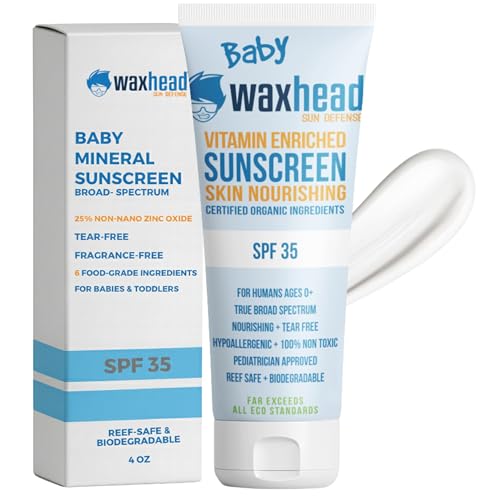
Overview: Waxhead Baby Sunscreen SPF 35 uses 25% non-nano zinc oxide – the highest mineral concentration in this comparison – in a thick lotion designed specifically for newborns, infants, and toddlers from 0 to 24 months. It is tear-free, reef-safe, and water-resistant, with a visible white coverage layer that allows parents to confirm even application on delicate infant skin.
25% zinc oxide is the highest mineral UV filter concentration in this comparison by a meaningful margin. Higher zinc content means more physical UV-blocking material on the skin surface, which translates to more reliable broad-spectrum coverage – particularly relevant for infant skin, which is thinner, has lower melanin concentration, and is more UV-sensitive than older children or adults. The higher concentration also provides more photostable protection that maintains efficacy throughout extended sun exposure.
The visible white layer that comes with 25% zinc concentration is a deliberate feature for infant use rather than a cosmetic compromise. Parents can see precisely where sunscreen has been applied and identify coverage gaps before going outdoors – a practical advantage that outweighs the cosmetic white cast in the newborn-to-toddler use scenario. The 0-24 months age range is the most conservative and carefully validated pediatric category, with formulation standards that exceed what is required for older children. At 4 oz, it provides more volume than travel-sized alternatives and supports generous daily application to face, neck, and exposed body areas throughout infancy.
Pros
25% zinc oxide provides the highest physical UV-blocking concentration in this comparison
Visible white coverage allows parents to confirm even application on infant skin and identify missed areas
0-24 months formulation – the most conservative and thoroughly validated age range in this comparison
4 oz volume supports generous daily application without frequent repurchasing
Tear-free and reef-safe – appropriate for face application and ocean or pool environments
Cons
SPF 35 is lower than SPF 50 options – though the 25% zinc concentration provides strong inherent physical protection
High zinc concentration leaves a visible white cast – not cosmetically suitable for older children or adults
Thick texture requires more blending effort than lighter lotion alternatives
Best for Parents of newborns and infants under 24 months who want maximum physical zinc oxide concentration and visible application confirmation on the most delicate skin, prioritizing safety credentials over cosmetic finish.
Loading comments...