Loading...
Best 3-Channel Dash Cam 2026 — Front, Cabin & Rear Coverage
Three-channel dash cams record front, cabin, and rear simultaneously — covering every angle for accidents, parking incidents, and rideshare documentation. We compare the top 3-channel systems on sensor quality, night vision, WiFi connectivity, and value to find the best full-coverage setup for your car.
As an Amazon Associate I earn from qualifying purchases at no cost to you – it keeps the site running.
As an Amazon Associate I earn from qualifying purchases at no cost to you – it keeps the site running.
Vantrue N4S 3-Channel Dash Cam

Overview: Vantrue N4S is the premium pick — a 3-channel system covering front, cabin (inside), and rear simultaneously with STARVIS 2 night vision and Vantrue's proprietary PlatePix™ technology for enhanced license plate capture. For drivers who want comprehensive vehicle coverage across all angles with the brand quality that VANTRUE is known for in the enthusiast dash cam market, the N4S is the reference-grade option in this comparison.
VANTRUE's positioning in the dash cam market is enthusiast-grade build and image quality — a level above the budget brands that dominate by price but fall short on low-light performance and construction. The N4S's STARVIS 2 sensor (Sony's second-generation back-illuminated CMOS, optimized for low-light) provides night recording quality that budget CMOS alternatives don't match. The difference is most visible in parking lot and nighttime street footage where plate legibility and scene detail separate adequately-lit from genuinely useful incident evidence.
PlatePix™ is VANTRUE's proprietary license plate capture enhancement — processing tuned specifically for reading plates in forward-facing footage across varying distances and lighting conditions. For the core insurance-claim use case where a plate read from dash cam footage determines fault assignment, this technology has direct practical value. 3-channel coverage (front + cabin + rear) addresses a second limitation of single-channel alternatives: rear-end collisions and cabin incidents (parking lot door dings, interior disputes, rideshare recording) require rear and cabin channels that single-channel cameras fundamentally cannot cover. WiFi, GPS, and parking mode round out the feature set; support for up to 1TB SD cards provides extended continuous recording capacity for rideshare drivers or long-haul use.
Pros
3-channel coverage: front + cabin + rear — comprehensive vehicle protection for all incident types
STARVIS 2 night vision – Sony's best CMOS generation for low-light plate legibility and scene detail
PlatePix™ technology – proprietary license plate capture enhancement for incident documentation
Up to 1TB SD card support – extended recording for rideshare or long-haul use
WiFi + GPS + Parking Mode – full feature set at premium tier
VANTRUE brand quality – enthusiast-grade build vs. budget alternatives
Cons
Premium price – highest cost in this comparison
3-channel installation requires routing 3 camera cables vs. single-channel simplicity
15% discount rate vs. budget alternative's offer period
Best for Drivers who want comprehensive 3-channel coverage with STARVIS 2 night vision and premium build quality, and are willing to pay the premium tier price for VANTRUE's reference-grade feature set.
WOLFBOX i17 4K 3-Channel Dash Cam

Overview: WOLFBOX i17 delivers 4K+1080P+1080P triple-channel coverage — front, cabin, and rear — with 5.8GHz WiFi, GPS, and a 3-inch touchscreen at a mid-tier price between VANTRUE's premium and Veipho's budget 3-channel entry. The 64GB card included out of box reduces the immediate accessory cost, and 24-hour parking mode extends protection when the car is unattended.
WOLFBOX i17's 4K front channel provides the resolution headroom for plate legibility in forward-facing incident footage, while the 1080P cabin and 1080P rear channels cover interior and trailing incidents at lower resolution — a standard allocation for 3-channel systems where front quality takes priority. The 5.8GHz WiFi band provides faster footage transfer and lower interference than 2.4GHz in congested wireless environments, which matters for regular footage review cycles.
The 3-inch touchscreen is a practical installation benefit: configuring recording settings, reviewing clips, and adjusting camera positioning is significantly easier with a touchscreen interface than button-operated displays on competing units at this price tier. IR night vision covers the cabin channel specifically — the infrared LEDs illuminate the interior for clear facial and interior detail capture in low-ambient-light conditions, which is relevant for rideshare recording and overnight parking incidents. GPS embeds location and speed data, and WDR handles high-contrast lighting transitions (tunnel exits, sunrise/sunset driving) where standard exposure fails. 24-hour parking mode keeps the system recording on motion or impact detection when the engine is off.
Pros
4K front + 1080P cabin + 1080P rear – comprehensive triple-channel coverage
5.8GHz WiFi – faster, lower-interference footage transfer than 2.4GHz alternatives
3-inch touchscreen – easier settings navigation vs. button-operated competitors
IR night vision – illuminated cabin recording for rideshare and overnight parking incidents
64GB card included – reduces immediate out-of-box accessory cost
24H parking mode – continuous protection when unattended
GPS – speed/location metadata embedded in video
Cons
⚠️ Campaign offer expires soon — check for updated pricing before purchase
Cabin and rear channels at 1080P vs. VANTRUE's STARVIS 2 sensor quality
WOLFBOX is a mid-tier brand vs. VANTRUE's enthusiast-grade positioning
Best for Drivers who want 4K 3-channel coverage with a touchscreen interface, 5.8GHz WiFi, and an included SD card at mid-tier pricing between budget and premium alternatives.
REDTIGER F17 4K 3-Channel Dash Cam

Overview: REDTIGER F17 brings STARVIS 2 IMX675 HDR sensor technology into the 3-channel mid-tier segment — a meaningful upgrade over standard CMOS sensors at comparable pricing. 4K+1080P+1080P triple coverage, 5.8GHz WiFi, GPS, and 64GB included card position the F17 as the image-quality-first choice in the mid-range 3-channel bracket.
The STARVIS 2 IMX675 is the F17's key differentiator versus the WOLFBOX i17 and Veipho alternatives in this comparison. Sony's second-generation back-illuminated CMOS — the same sensor family as VANTRUE N4S uses — provides substantially better low-light performance than standard CMOS alternatives: higher sensitivity, lower noise floor, and better HDR handling for high-contrast lighting transitions. In the mid-tier 3-channel category, having STARVIS 2 quality in the front channel is an uncommon combination that REDTIGER achieves with the F17.
HDR (High Dynamic Range) processing complements the IMX675 sensor for balanced exposure across scenes that mix bright and dark zones — highway driving into direct sunlight, tunnel exits, and night driving with oncoming headlights are conditions where standard WDR struggles and HDR maintains usable detail across the full frame. 5.8GHz WiFi and GPS match the WOLFBOX i17's connectivity tier; IR night vision covers the cabin channel for interior low-light recording. The 64GB card included reduces day-one accessory spend. For buyers who prioritize front channel image quality in a 3-channel system and want STARVIS 2 HDR capability at mid-tier pricing, the F17 delivers it.
Pros
STARVIS 2 IMX675 HDR – Sony's second-gen CMOS with superior low-light performance vs. standard sensors
HDR processing – balanced exposure across high-contrast scenes (tunnels, direct sun, night headlights)
4K front + 1080P cabin + 1080P rear – full triple-channel coverage
5.8GHz WiFi + GPS – current-generation connectivity
IR night vision – cabin channel infrared for low-light interior recording
64GB card included – ready to use out of box
Cons
⚠️ Campaign offer expires very soon — check for updated pricing before purchase
Cabin and rear channels at standard 1080P despite STARVIS 2 front sensor quality
REDTIGER is a known mid-tier brand, but lacks VANTRUE's enthusiast-grade hardware reputation
Best for Mid-range 3-channel buyers who prioritize front-channel image quality and want STARVIS 2 HDR sensor performance without paying VANTRUE premium pricing.
Veipho 4K 3-Channel Dash Cam
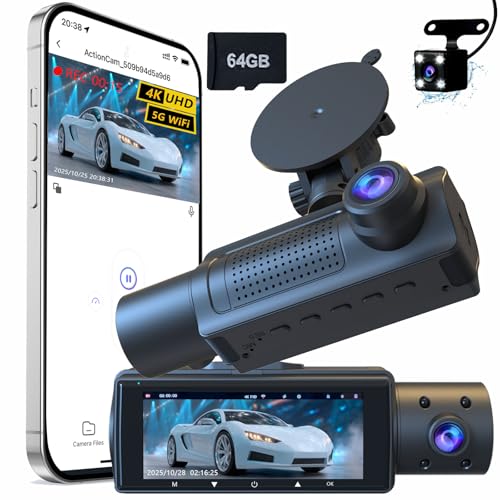
Overview: Veipho's 4K 3-channel dash cam leads this comparison on app connectivity, combining 5GHz WiFi with a dedicated app for live preview and clip management — a convenience feature that most competing units handle less smoothly. 2160P+1080P+1080P triple coverage with 360° front camera positioning and a 64GB card included make the Veipho a strong value-per-feature option in the mid-range 3-channel bracket.
Veipho's 5GHz WiFi with app control is more than a connectivity checkbox: the companion app enables live preview from the front, cabin, and rear cameras on a smartphone screen — useful for verifying camera angle alignment after installation without sitting in the car squinting at a small dash-mounted screen. Clip browsing and footage download happen in the app rather than requiring SD card removal and a card reader, which reduces friction for regular footage review cycles. The 5GHz band provides faster transfer speeds than 2.4GHz alternatives when downloading 4K clips.
The 360° front camera is a physical differentiation: rather than a fixed-angle front unit, the rotating mount allows precise angle adjustment for a wider range of windshield positions and vehicle types without adapter brackets. 2160P (4K) front recording provides the resolution headroom for plate legibility; the cabin (1080P) and rear (1080P) channels cover interior incidents and rear-end collisions. G-Sensor triggers automatic incident locking to prevent footage overwrite; night vision and WDR extend usable recording into low-light and high-contrast conditions. The parking monitor activates on motion or impact detection when parked. For buyers who value app-driven usability and 360° mount flexibility alongside 3-channel coverage, the Veipho is the convenience-first pick in this comparison.
Pros
5GHz WiFi with app control – live preview and clip management from smartphone, no card removal needed
360° rotating front camera – precise angle adjustment for any windshield position
4K (2160P) front + 1080P cabin + 1080P rear – full triple-channel coverage
64GB card included – ready to use out of box
G-Sensor automatic incident locking – prevents important footage from being overwritten
Parking monitor – motion/impact-triggered recording when unattended
Cons
Veipho is a newer brand with limited multi-season reliability track record vs. established alternatives
No STARVIS 2 sensor – standard CMOS vs. REDTIGER F17's IMX675 at comparable tier
App-dependent workflow may have UX inconsistencies typical of newer brand software
Best for Drivers who prioritize app-connected usability and 360° mount flexibility in a 3-channel dash cam, and want live preview and smartphone footage management as first-class features.
Loading comments...