Loading...
Best FPV Drone Recommendation 2026 — Picks for Beginners and Up
February 1, 2026FPV drones range from serious digital-goggles kits to palm-sized indoor micro drones — and knowing which fits your skill level and use case saves both money and frustration. This comparison covers four distinct entry points: a genuine RTF FPV kit with Walksnail digital video transmission, and three HISINGY micro drones progressing from optical-flow-assisted hover down to simplified toy-grade controls. Whether you are stepping into real first-person view or buying a first indoor flyer for a beginner, each pick here targets a specific need rather than a price tier.
As an Amazon Associate I earn from qualifying purchases at no cost to you – it keeps the site running.
CADDXFPV Protos FPV Drone RTF Kit

Overview: The CADDXFPV Protos is a genuine RTF (Ready to Fly) FPV kit that includes everything needed to start flying with real digital FPV goggles — no additional purchases required. Built with Walksnail digital VTX delivering 1080p/60fps live feed to the included 4.5" goggle screen, it offers near-zero latency first-person view straight out of the box. Three flight modes let beginners start in stability mode and progress toward freestyle and racing, while the 3-in-1 charging hub keeps three included batteries cycling efficiently between sessions.
What separates the Protos from toy "FPV" drones is the Walksnail digital video transmission system — the same technology used in serious FPV racing setups, packed into a beginner-accessible RTF kit. The 4.5" goggle screen provides immersive first-person flying without requiring a separate headset purchase, making this one of the most complete and legitimate entry points into real FPV available today. CADDXFPV builds components used by competitive FPV pilots worldwide, so the brand credibility behind the hardware is genuine.
Three flight modes provide a structured progression path: stability mode holds the drone level when sticks are released — ideal for learning directional control — while horizon and acro modes remove the leveling assist progressively, eventually enabling full freestyle and racing maneuvers. The 3-in-1 charging hub is a practical inclusion: simultaneous charging of all three batteries reduces turnaround time between flight sessions significantly compared to sequential single-battery chargers. For a beginner investing in real FPV, this kit eliminates the research and compatibility guesswork that typically surrounds component-based FPV builds.
Pros
Complete RTF kit — goggles, drone, 3 batteries, and charging hub included, no extras needed
Walksnail digital VTX — 1080p/60fps HD with near-zero latency vs. analog systems
3 flight modes — structured stability-to-acro progression path for skill development
3-in-1 charging hub — simultaneous battery charging reduces downtime between sessions
Legitimate FPV brand — CADDXFPV builds components used by competitive racers worldwide
Cons
Higher price point than toy FPV alternatives — investment in real FPV hardware
Requires outdoor flying space — not suitable for tight indoor rooms like micro whoop alternatives
Learning curve in acro mode — mastery takes repeated practice sessions beyond stability mode
Fixed 4.5" goggle screen — not upgradeable to modular headset systems as skills advance
Best for Beginners who want to enter real FPV — not toy-grade simulation — with a complete all-in-one kit that includes digital goggles and provides a genuine skill progression path toward freestyle and racing.
HISINGY FIREFLY EX Tiny Drone for Kids

Overview: The HISINGY FIREFLY EX is a palm-sized indoor micro drone targeting the 10–15 age range, with altitude hold keeping it at a set height so beginners can focus on directional control rather than throttle management. Headless mode removes the need to track the drone's orientation — the controller always responds relative to the pilot's position, which significantly reduces early-stage crashes and disorientation. Three speed settings let kids start slow and increase challenge as skills develop.
The FIREFLY EX sits in the entry-to-intermediate space — it is not a toy with zero feedback, but it is not a real FPV system either. Altitude hold and headless mode are genuine learning aids that make first flights survivable for kids who have never piloted a drone before. Altitude hold is barometer-based, maintaining a consistent flight height when the throttle stick is in the center position, which eliminates one of the most common beginner mistakes: forgetting to hold throttle and watching the drone drop suddenly.
Headless mode solves the orientation challenge that trips up nearly every first-time pilot: without it, the drone moves relative to its own facing direction — push forward and the drone moves wherever its nose is pointed, not necessarily away from the pilot. With headless mode active, forward always means away from the pilot regardless of where the drone is facing, which removes an entire category of confusion during early flights. Flight time is reported as longer than typical micro drones in this class, which reduces the frustration of constant recharging during learning sessions.
Pros
Altitude hold — automatically maintains height so beginners focus on directional control
Headless mode — orientation-independent controls remove a major beginner confusion point
3 speed settings — graduated challenge from slow learning mode to faster flight
Palm-sized form factor — safe for indoor flying without risk of property damage
Longer flight time for its class — more flying per charge vs. typical micro drones
Cons
No camera — flying trainer only, no video or FPV capability
Indoor-only practical use — wind makes outdoor flying difficult at this size
Brushed motors — shorter lifespan and less power than brushless alternatives
No optical flow — altitude hold is barometer-based, less precise than camera-assisted hover
Entry-level build quality — not designed for repeated hard crashes or outdoor conditions
Best for Kids aged 10–15 who want a first drone with real flight controls — altitude hold and headless mode remove the steepest beginner barriers while 3 speed settings provide a clear progression path indoors.
HISINGY MACH 500 Tiny Drone Kit

Overview: The HISINGY MACH 500 upgrades the hover precision with optical flow positioning — a downward-facing camera sensor that actively tracks the surface below and corrects drift, delivering noticeably steadier holds than barometer-only altitude hold. LED lights make it visually engaging for younger pilots and improve orientation readability during indoor sessions. It targets the 8–15 age range but offers more precise hovering than the FIREFLY EX, making it accessible for tighter indoor spaces and slightly younger beginners.
Optical flow is a meaningful hardware upgrade at this price point — it is the same positioning technology used in higher-end consumer drones to maintain stable indoor hover without GPS. For a micro drone, this translates to less drift during hands-off hover and easier control for beginners who are not yet skilled at constant throttle and stick corrections. Where barometer-based altitude hold only manages vertical position, optical flow manages lateral drift too — a substantially steadier experience in still indoor air.
The LED lights serve a practical function beyond aesthetics: in indoor low-light conditions or during dusk flying, the LEDs make the drone's orientation immediately readable from a distance. Knowing which direction the drone is facing is a foundational skill for new pilots, and visual cues from LEDs accelerate that learning. Three speed settings follow the same graduated difficulty approach as the FIREFLY EX — slow speed provides maximum reaction time during learning, while higher speeds introduce more responsive handling as control improves. The optical flow sensor works best over textured surfaces, which covers most indoor environments.
Pros
Optical flow positioning — camera-assisted hover precision vs. barometer-only alternatives
LED lights — visual orientation aid and enables low-light flying sessions
3 speed settings — gradual difficulty increase as skills develop
Suitable from age 8+ — optical flow makes hover more accessible for younger beginners
Indoor-safe form factor — lightweight enough to avoid property damage
Cons
No camera for video capture — flying trainer without any recording capability
Brushed motors — shorter lifespan than brushless alternatives in higher-tier drones
Limited outdoor use — small size makes it vulnerable to any wind
Optical flow precision drops over solid-color floors — works best over textured surfaces
No headless mode — beginners must learn orientation tracking earlier than with FIREFLY EX
Best for Younger beginners aged 8–12 who benefit from optical flow's steadier hover without needing to master constant throttle corrections — a practical step up from basic toy drones before moving to camera-equipped models.
HISINGY SKYBREAKER Toy Drone for Kids
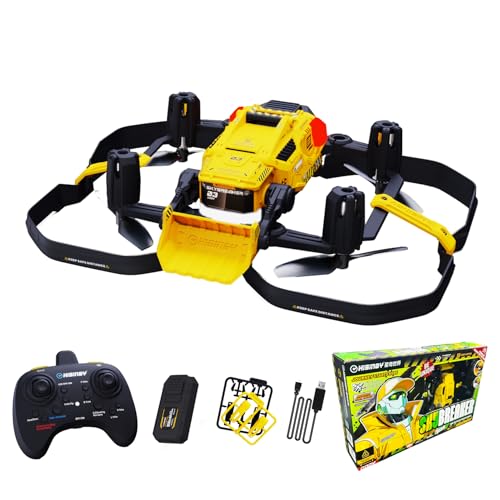
Overview: The HISINGY SKYBREAKER is a gift-oriented toy drone for children aged 8–15, with LED lights, three speed settings, and a micro form factor designed for safe indoor use. It is the most accessible entry point in this comparison — straightforward to fly with simplified controls that prioritize crash survivability and first-flight approachability over feature depth. LED lighting adds visual appeal and orientation readability for younger pilots during indoor sessions.
The SKYBREAKER is the right choice when the goal is a gift that flies without complexity — not a training tool toward real FPV skills. Its simplified control scheme means kids can get airborne within minutes without setup or configuration, and the micro size limits the potential for damage during inevitable early crashes. Unlike altitude hold or optical flow models, the SKYBREAKER requires active throttle management, which is actually useful as a long-term skill builder once a child is ready to move beyond fully assisted flight.
LED lights are both a visual appeal feature and a practical orientation tool — identifying the front of the drone from a distance is easier when one side lights differently from the other. Three speed settings allow younger kids to start on minimum throttle response before increasing to faster modes as control improves. The micro size means it is genuinely apartment-safe: at this weight and speed, contact with furniture or walls causes the drone to bounce rather than break, and the propeller guards protect both the drone and surfaces from the inevitable learning crashes.
Pros
Simple controls — minimal setup, flyable within minutes for complete beginners
LED lights — visual engagement and orientation aid during indoor sessions
3 speed settings — adjustable difficulty for different ages and skill levels
Micro size — low crash damage risk indoors, safe around younger kids
Gift-ready packaging — priced and packaged for casual gifting occasions
Cons
No altitude hold — requires active throttle management vs. hands-free hover alternatives
No optical flow — more drift during hover vs. sensor-assisted competitors
No camera — no video or FPV capability
Brushed motors — limited lifespan, not designed for extended regular use
Entry-level build — not suited for outdoor use or frequent hard landings
Best for Casual gifting for kids aged 8–12 who have never flown a drone — simplified controls and micro size make first flights achievable without frustration, with LED lights adding visual appeal for the youngest audiences.
Loading comments...